
Peer Review and Editorial Policies
1.Publication process
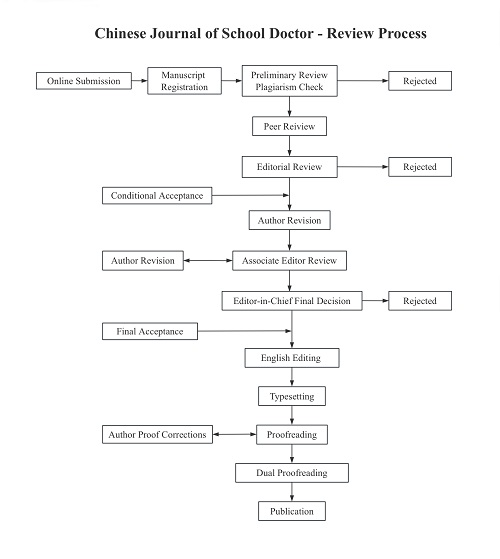
The manuscripts submitted to this journal undergo a five-stage review process, comprising editorial office preliminary review, expert peer review, editorial review, editor re-review, and editor-in-chief final-review.
In the preliminary review stage, academic misconduct detection is first conducted via the China National Knowledge Infrastructure (CNKI) platform. Manuscripts that pass this screening will receive an initial assessment by the editor-in-chief and will then be sent to at least two peer experts for external review. The expert peer review focuses on evaluating the manuscript’s originality, research design, data authenticity, statistical methodology, and ideological correctness.The re-review stage mainly examines the standardization of text expression, figures, tables, and references, as well as the accuracy of statistical applications. It also integrates the opinions from the preliminary review and peer review to provide recommendations on whether to accept the manuscript, along with evaluations. For manuscripts requiring revisions, editors shall propose specific modification suggestions and contact the authors for revisions. Authors are required to revise their manuscripts according to the review comments until they meet the publication standards.
Finally, the editor-in-chief will organize an editorial meeting to make an acceptance decision after comprehensively considering the opinions from all stages. The specific process is illustrated in the figure below:
2. Editorial and ManuscriptPolicies
Themanuscript is the full responsibility of the author. While respecting the author’s academic perspectives, this journal reserves the right to make necessary modifications and deletionin manuscripts accepted for publication. If the author disagrees with any proposed revisions, the reasons should be stated in the feedback response.
After submission, authors can track the review progress in real time through the online system. Thereview process will be generally completed within three months. If an author intends to submit the manuscript to another journal, prior contact with the editorial office of this journal is required.
Authors are expected to submit the revised manuscript within the specified deadline after receiving the revision comments. Failure to respond within the stipulated period will be regarded as an automatic withdrawal of the manuscript.
3. Appeal Policy
If authors who disagree with the reviewers’ or editors’ decisions, an appeal may be filed following the established procedure. Appeals must be submitted in writing, include the manuscript ID, and sent to zgxybjb@126.com. The appeal letter should provide detailed reasons, addressing the review comments comprehensively and reasonably, and must be stamped by the author’s affiliated institution to be valid. The editorial office will determine whether to accept the appeal based on the specific situations.
4. Editorial Board and editor Submission Management Policy
Submissions by editorial board members and editors must adhere to the journal’s unified review and editorial procedures, and are subject to the same review standards as those applied to other authors. To ensure impartiality, editorial board members, editors, and their family members or colleagues shall not participate in the review, editing, or acceptance decisions regarding their own submissions. If the author of a manuscript is the editor-in-chief, the deputy editor-in-chief shall be responsible forthe submission. Peer review shall be conducted independently, and editors and editorial board members must recuse themselves from manuscripts in which they have competing interests, collaborations, or other conflicts of interest.
5. Correction and Retraction Policy
Articles that have been officially published in this journal generally do not accept unsolicited correction or retraction requests from authors. However, when truly necessary, the editorial office will handle such cases according to specific situations.
(1) Correction: If a published article is found to contain non-intentional, inadvertent scientific errors that do not affect the main results and conclusions, the editorial office will issue a correction statement explaining the modifications and publish the corrected version. The updated article will be marked with the revision date and a note of the changes, and citations should refer to the latest version.
(2) Retraction: The editorial office will initiate a retraction procedure under the following circumstances:① When an article contains serious scientific errors that render the results and conclusions unreliable;② When a manuscript is suspected of academic misconduct (such as plagiarism, data fabrication or manipulation, improper authorship, etc.).
In such cases, the editorial office will conduct an investigation and issue a risk notice. After the investigation, if academic misconduct is confirmed, the article will be formally retracted and a retraction statement will be published to uphold academic integrity and publishing fairness.
 Editor-in-Chief: Ma Jun